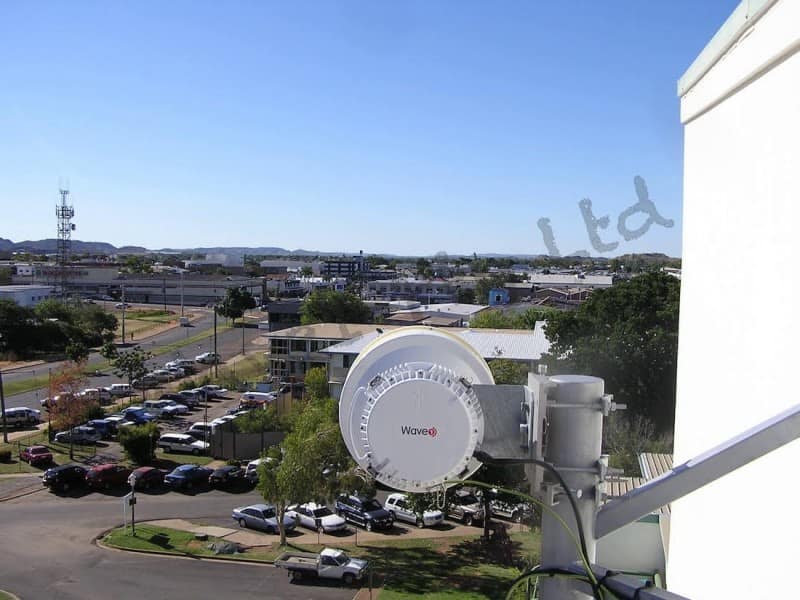
Improve communication between buildings with our quality wireless microwave links.
Do you need to communicate between multiple locations instantly without worrying about data latency or cable issues? Our wireless microwave link solutions use advanced microwave transmission technology to deliver high-capacity connectivity across short and long distances without physical cabling. Underground Cabling infrastructure is not required helping reduce installation costs for your communication network. Our team delivers dependable, engineered solutions tailored to your operational needs.
Point-to-Point vs Point-to-Multipoint Configurations
Wave1 designs bespoke network architectures to suit your specific organisational structure. A point-to-point setup creates a dedicated, high-capacity microwave communication bridge between two fixed locations, ideal for high-speed data backhaul. Alternatively, a point-to-multipoint configuration allows a central hub, such as a head office in the Sydney or Melbourne CBD, to connect seamlessly to multiple satellite warehouses or site offices.
What Sets Wave1 Apart Regarding Microwave Links
These are the key advantages of working with Wave1:
- Decades of industry experience: Our senior engineers have been with us for over 20 years, and we only employ the most talented technicians in the nation to make sure the quality of our service is second to none.
- Our ability to cater to all requirements: Our projects span government, telecommunications, education and commercial sectors. Each microwave communication link is tailored to specific site demands and operational requirements.
- Our commitment to customer care: We aim for 100% satisfaction with every client we serve. Ongoing support is focused on maintaining performance and minimising disruption. Issues are addressed promptly to support reliable day-to-day operations.
Related Services We Provide to Wireless Microwave Links
We provide a range of services supporting wireless microwave communications, including:
- Licensed and unlicensed microwave communication links: Licensed links use a dedicated frequency and require regulatory approval before installation, while unlicensed links can be deployed more quickly, with frequency planning used to reduce the risk of interference.
- Site surveys and assessments: We carry out site surveys to confirm line of sight and identify environmental factors that may affect performance. These assessments support accurate network design and help maintain long-term reliability.
- 24/7 link monitoring: We monitor network performance around the clock to identify faults and irregularities early. This supports faster response times and helps maintain reliable day-to-day operation.
Custom Wireless Solutions for Challenging Australian Terrains
Wave1 provides versatile microwave communication solutions designed to overcome the physical barriers of the Australian landscape. Whether your project involves spanning rivers, crossing major highways without the need for complex digging permits or reaching remote construction sites, our technology delivers.
In cities like Sydney, Melbourne and Brisbane, where underground trenching is often geographically impractical or cost-prohibitive, we provide a high-speed alternative. This capability is essential for the mining and infrastructure sectors, which require instant, reliable connectivity across demanding environments, with microwave transmission supporting consistent performance where traditional infrastructure is limited.
About Wave1
At Wave1, we’ve established ourselves as industry leaders in Australia in microwave communication technology over the past three decades. Our focus remains on delivering reliable, scalable connectivity solutions. If you want to find out how we can seamlessly connect all the buildings in your organisation, speak with our team to discuss a solution suited to your network requirements.